
At Satelligence, we use Earth Observation (EO) data to observe the status of earth’s landscapes in near real time. Our main data source is satellite-based from the USGS Landsat & EC Copernicus Sentinel programmes. These satellite constellations regularly collect raw data on a global scale which needs to be pre-processed (cleaned, corrected, harmonised), processed (combined, analysed, interpreted) and queried to turn it into actionable information for our clients.
In this article, we’ll explain how Satelligence does this with the help of our two proprietary systems, DPROF & GEODB, and why it’s not only the lines of code that matter. To conclude, we’ll draw from Jan Douwe van der Ploeg’s (Professor of Rural Sociology at Wageningen University) perspective on technology as socio-technical regimes.
DPROF & GEODB explained
DPROF
Since 2017, Satelligence has been continuously developing a satellite data processing system (referred to as Distributed Processing Framework – DPROF) in-house to crunch large amounts of raster data (a combination of satellite and other EO data) in parallel. DPROF automatically downloads, pre-processes, and applies geospatial analysis algorithms to Landsat, Sentinel-1, Sentinel-2, and any other raster data source. Again automatically, the system creates wall-to-wall mosaics and time-series composites from all available satellite images within a spatial and temporal domain.
With the help of Machine Learning (ML) methods like Random Forest, pre-processed satellite composites are used as input feature sets to create a forest baseline and commodity layers (cocoa, palm oil). ML training is carried out on relatively small areas, and DPROF is then used to apply this model to far larger geographies, such as the whole of Ghana, West Africa, or the world.
DPROF is also responsible for our ability to detect change in near real-time—an iterative Bayesian updating approach is used to flag and confirm change in satellite time series data.
GEODB
DPROF is able to process any amount of raster data at global scale into high quality, consistent, and coherent data products and then store them in the cloud. This is, of course, amazing… but our clients are not interested in pixels, they want their problems solved. We want to avoid propagating the data graveyard. After all, to paraphrase Will Cadell (Founder and CEO of Sparkgeo),“a pixel sold, is a problem sold”.
Here’s what our clients do want to know:
- Which plots in their supply chain are EUDR compliant
- Which countries or jurisdictions have the highest deforestation risk
- Where the highest GHG emissions are in their supply chain
- Where to invest to reduce environmental risk
In order to provide this information, we built a storage and query engine: GEODB. With this engine, we can query our geospatial data in real time. We are able to select, combine, filter, and aggregate any geospatial dataset (produced by Satelligence, one of our partners, or via public sources). GEODB is built on a lightweight, serverless cloud architecture which enables it to scale very quickly in the spatial and temporal dimension.
Both DPROF and GEODB are built exclusively with open source software components and designed with a cloud native architecture. This prevents vendor lock-in. Both for software components but also for cloud providers: “build for the cloud to become independent of the cloud”.
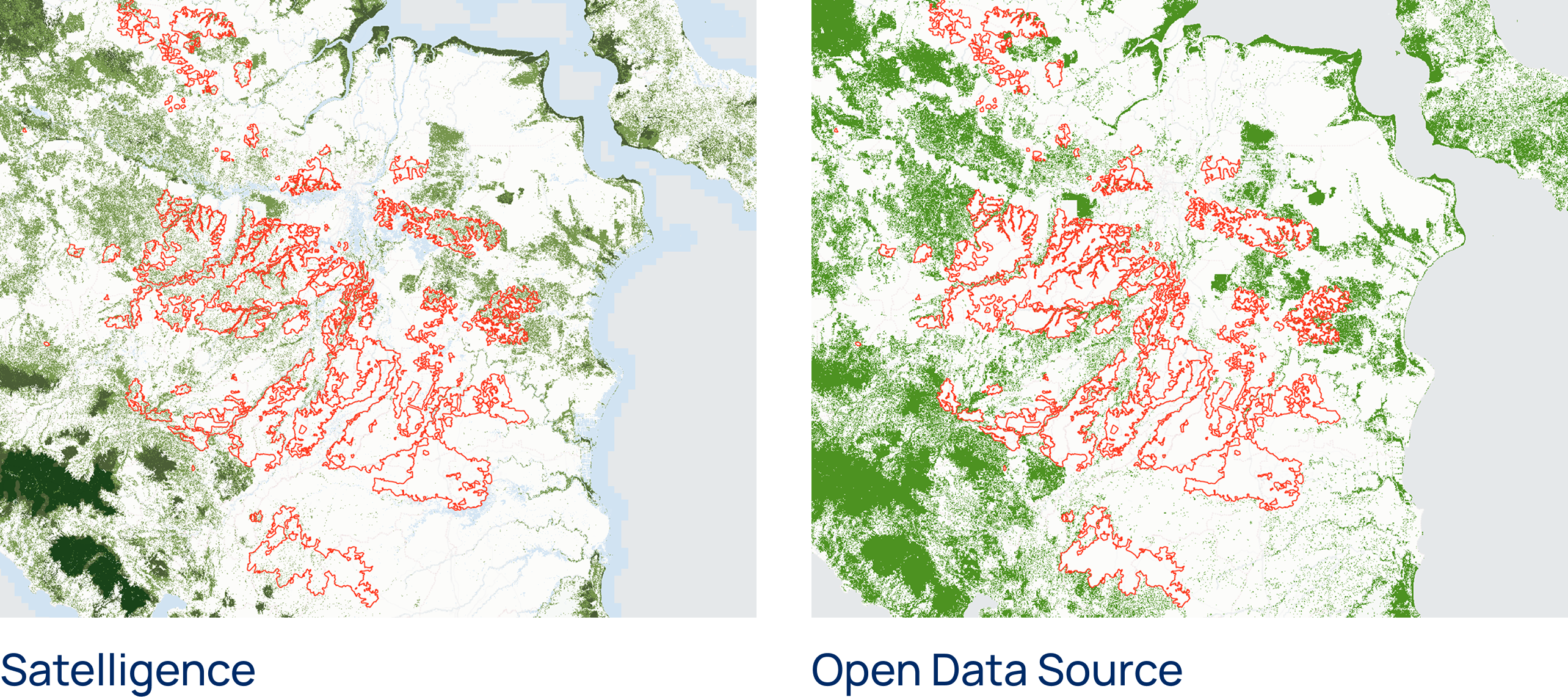
Satelligence forest baseline vs. open data source, South Sumatra.
Our proprietary DPROF and GEODB technologies turn satellite data into the most accurate forest and commodity maps, providing the precision needed for reliable monitoring and EUDR compliance.
Still…
… why did we create those engines in-house? Haven’t those problems already been solved? Isn’t the best code, the code you don’t need to write?
Well yes, and we did look at commercial off-the-shelf solutions when we started out in 2016, but these were either:
- Not available for commercial use
- Not feature complete
- Deterministic one-size-fits-all solutions that disregarded Contextual Intelligence
The latter point being the most important. Since day one of our existence, Satelligence has been very aware of the importance of the social, political, cultural and economic context of our mission: end deforestation. Embedding local context into our organisation has been the default from the beginning – across sales, product development, support and, also, engineering.
Beyond lines of code
Technology is neither neutral nor deterministic – it doesn’t follow a single, universal development path independent of cultural context. Jan Douwe van der Ploeg’s work demonstrates that technology is always culturally mediated, shaped by specific values, knowledge systems, and social relationships. DPROF and GeoDB are unique technologies made possible through co-production and cultural embeddedness, key themes in the work of Jan Douwe van der Ploeg.
Both of these systems enable us to build the world’s most comprehensive, consistent, and coherent data source lake with environmental geospatial data. In contrast to the scattered, inconsistent and incoherent public data sources where “you order a meal, you get a kitchen”, at Satelligence, “you order a meal, you get a meal”. DPROF and GEODB make up part of our kitchen where we prepare those meals.
About Satelligence
Satelligence is a geospatial sustainability company. Their curated and E&Y verified insights on deforestation, supply chains, land degradation, and downstream scope 3 emissions make product journeys and investment portfolios sustainable, from tree to shelf. They’re trusted by Cargill, Unilever, Mondelez, Bunge, AAK, Rabobank, IKEA, Tony’s Chocolonely, and more.