
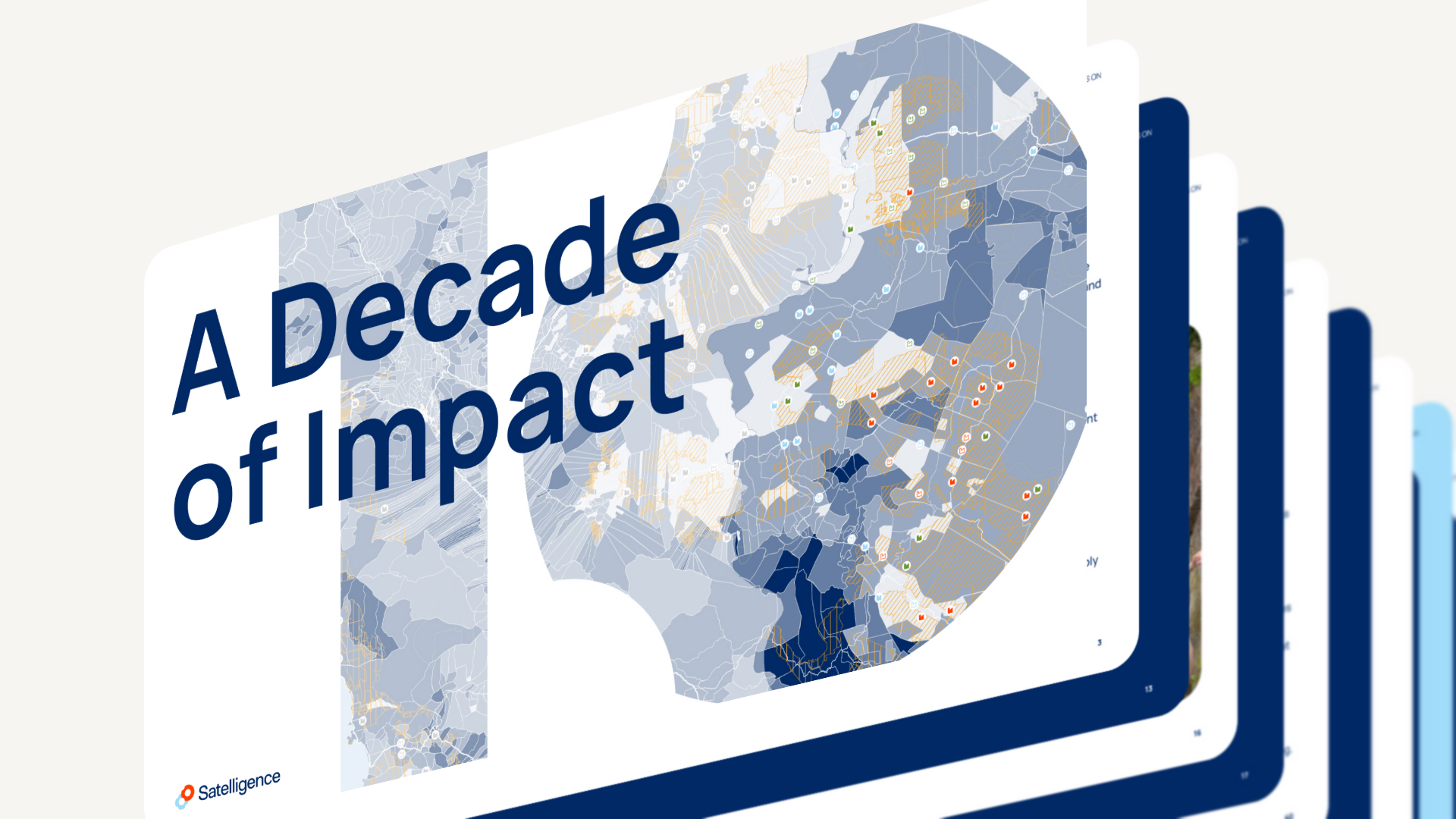
Satelligence publishes “A Decade of Impact” Report, defining Nature Intelligence as the operational standard for supply chain sustainability
Ten years of building the analytics infrastructure that connects environmental performance to business decisions—and the case for what comes next
Utrecht, Netherlands — 18 November, 2026
Satelligence, the Nature Intelligence company, today published its A Decade of Impact Report, marking 10 years of building the analytics infrastructure that enables the world’s largest food and beverage companies, chemicals brands, and traders to monitor, measure, and act on nature and climate risk across their supply chains.
The report introduces Nature Intelligence as a defined category: contextual, actionable insights embedded in the procurement, compliance, and financing decisions that determine how companies source and operate. Where deforestation monitoring was the question a decade ago, Nature Intelligence is the answer today—spanning deforestation and land use conversion, carbon emissions and removals, biodiversity, and water risk in a single, consistent picture.
We set out to build something that didn’t exist: a way for brands, traders, retailers and investors to see exactly what is happening in the landscapes their supply chains depend on—and to act on it. The market is now ready for Nature Intelligence. The clients that built this capability earliest are already better positioned, and the report is a record of how that happened.
Niels Wielaard, CEO, Satelligence
The infrastructure behind Nature Intelligence
Satelligence’s geospatial data refinery processes over one billion hectares of satellite data daily, combining radar and optical imagery feeds, stripping out cloud cover and atmospheric interference, and running planetary-scale models across the world’s most critical sourcing regions. One primary output is the Harmonised Nature & Commodity Baseline (HNCB), an independently validated, continuously updated global crop and land cover map series at 10-metre resolution available in all sourcing regions that matter most for supply chain risk.
In 2026, Satelligence published the first cross-commodity Deforestation- and Conversion-Free (DCF) methodology in the agricultural sector, a single consistent framework across palm oil, cocoa, coffee, soy, rubber, and other forest-risk commodities, independently reviewed by Control Union Malaysia and aligned with the Consumer Goods Forum Forest Positive Coalition. For the first time, companies can assess DCF performance consistently across commodities, geographies, and reporting frameworks.
From deforestation alerts to sourcing strategy
Sustainability and procurement teams at companies including Nissin, SD Guthrie, and Grepalma use Satelligence. The report documents how that use has changed: from responding to deforestation alerts to restructuring sourcing strategies, from annual sustainability reporting to operational decisions embedded in day-to-day workflows. Among the case studies documented, SD Guthrie used Satelligence’s methodology to deliver 40,250 metric tons of EUDR-compliant palm oil to Europe, the company’s first fully verified shipment ahead of the new rules.
At Nissin Food Holdings, forest monitoring scaled from a six-month pilot in Sumatra to a full global palm oil supply chain programme. Satellite-based insights now connect to individual suppliers, supporting targeted engagement, smallholder programmes, and nature-related financial disclosures in line with the Task Force on Nature-related Financial Disclosures (TNFD) LEAP framework.
Our collaboration with Satelligence has transformed our sustainability initiatives by turning complex challenges into clear, data-driven actions that create measurable impact.
Kaya Tanii, Head of Sustainability Strategy at Nissin Food Holdings.
The decade ahead
4impact Capital, the Dutch impact investment fund backing Satelligence since 2020, sees the shift reflected in how capital is moving.
“We see Satelligence as the ground truth for supply chains, enabling companies to have the resilience and certainty in their sourcing processes. Nature Intelligence overlays that, which is the power that Satelligence delivers. Enabling very complex data to be translated into a very usable format that is also audit-ready—that is really powerful,” said Ali Najafbagy, Founding Partner at 4impact Capital.
The report sets out the direction of the work ahead. AI-driven scenario planning tools with human governance will allow companies to model the nature and climate implications of a sourcing decision before making it, moving Nature Intelligence from a reporting tool to a strategic one.
Companies incorporating biodiversity and water risk indicators will have a single, coherent view of broader risk exposure across their supply chains in minutes instead of weeks. Those investing in restoration pilots in high-risk sourcing regions will uncover where investment within a supply chain delivers the greatest measurable return—sequestering carbon, improving ecosystem connectivity, and building long-term supply resilience from within.
The full report is available to download here.
About Satelligence
Satelligence is the satellite-powered geo-data analytics company delivering Nature Intelligence for global supply chains. It provides real-time insights into agricultural production and supply chain risks—including deforestation, carbon, biodiversity and water—empowering leading companies like Grepalma, SD Guthrie and Nissin to measure, manage, and mitigate nature and climate commitments. By providing consistent, audit-ready supply chain insights, Satelligence helps businesses drive profitability while fostering an equitable, climate-positive future. With offices in Utrecht, Jakarta, Abidjan, and São Paulo, it is committed to protecting businesses, people, and the planet.
For media inquiries contact media@satelligence.com
Christina Gonzales: gonzales@satelligence.com
Ellie Pritchard: pritchard@satelligence.com