


Satelligence and Google Cloud scale global deforestation monitoring using satellite AI technology.
Ten years ago, our team at Satelligence was running early forest monitoring operations on just one virtual machine, manually processing satellite imagery for small regions in Indonesia and Malaysia. Today, that mission has scaled to a global system analysing deforestation, carbon emissions, and biodiversity across the world’s commodity-producing regions – powered by thousands of automatically orchestrated virtual machines on Google Cloud.
We were delighted to look back on this transformation in a new case study interview in collaboration with Google Cloud. Our Director of Technology, Rens Masselink, reflects on the journey from early infrastructure to a highly scalable global data platform.
Building a forest monitoring foundation that doesn’t compromise
As environmental regulations tighten (most notably the EU Deforestation Regulation), supply chain transparency has shifted from a voluntary sustainability ambition to a core requirement for market access.
To meet this demand, Satelligence sought an infrastructure partner capable of scaling data volume and with an appetite to grow further. We found that partner in Google Cloud.
By building custom processing pipelines on Google Cloud’s flexible and scalable infrastructure, we were able to establish a monitoring foundation that could handle large volumes of satellite imagery and geospatial data, whilst maintaining a high level of reliability and speed.
Automating the process
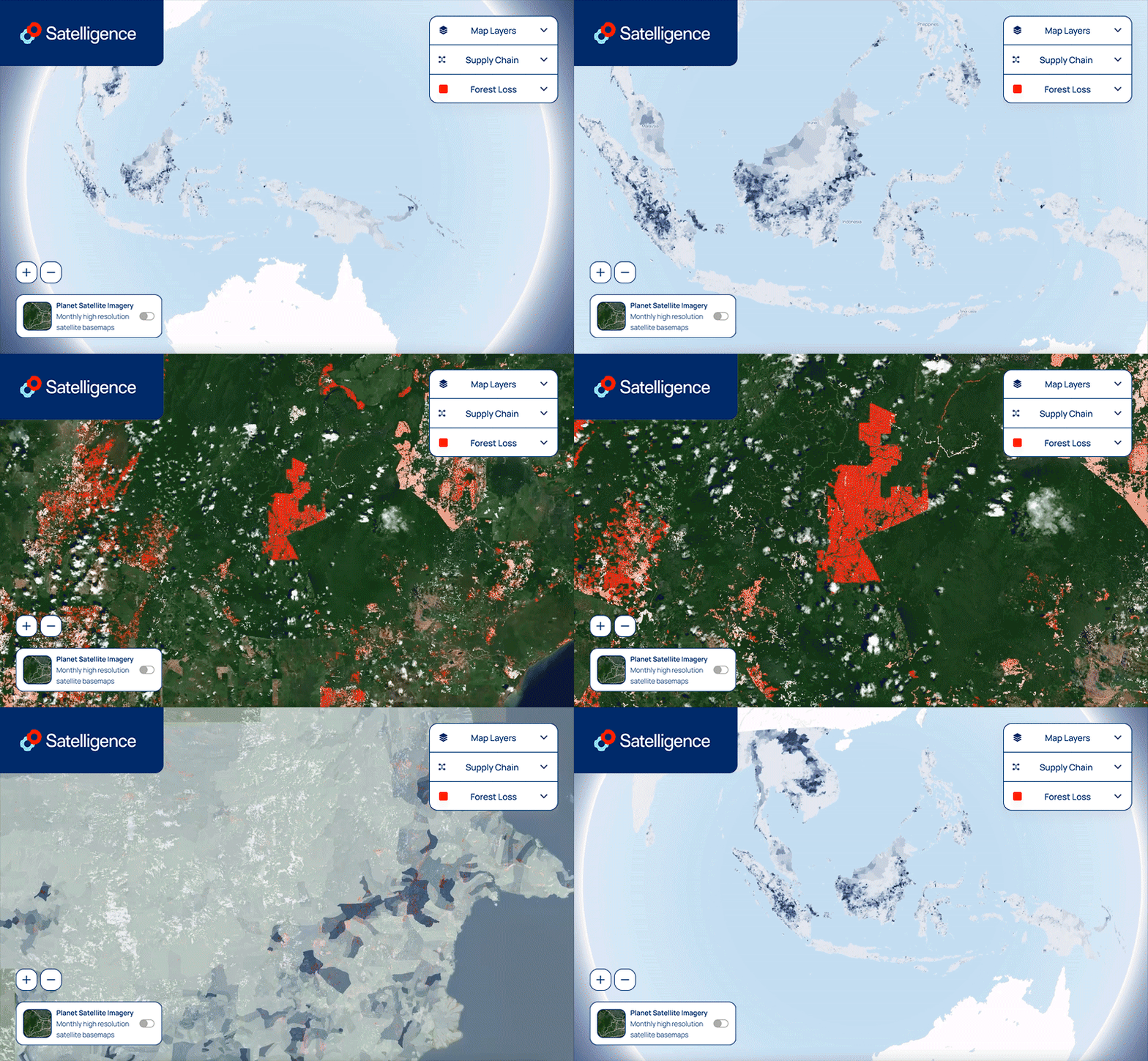
Today, Satelligence operates a fully cloud-native, API-first platform that scales dynamically to thousands of virtual machines when needed.
What once required manual monitoring and constant engineering attention now happens automatically in the background, enabling our team to focus on what matters most: delivering trusted, actionable insights that help companies make better sustainable sourcing and business resilient decisions across deforestation, carbon, and biodiversity impacts.
This shift has enabled three core capabilities that define Satelligence’s current nature intelligence platform:
- Global footprint monitoring
Scaling across geographies, commodities, and compliance frameworks to deliver clear, consistent, and credible insights anywhere in the world.
- Embedded nature intelligence
An API-first approach that enables nature intelligence to be integrated alongside operational and financial datasets.
- Uncompromising data integrity
Delivering verified, transparent, and reliable data that organisations can trust when making critical sourcing and compliance decisions.
Empowering strategic decision-making
As Rens explains: “The past ten years have been about building a monitoring layer. The next ten years are really about the decision layer, helping our clients act in real time. Foundation models will help us improve our commodity maps, large language models will help our clients interact with our data.”
- Near-real time monitoring
Instead of only identifying deforestation, the goal is to enable organisations to act on nature intelligence in near-real time – embedding sustainability directly into procurement, sourcing, and financial decision-making.
- Designed to scale
This evolution has been supported by a technology stack designed to scale alongside growing demand for sustainability intelligence.
The combination of cloud infrastructure, satellite data, and AI has enabled Satelligence to expand its monitoring capabilities from regional projects to truly global coverage.
The past ten years have been about building a monitoring layer. The next ten years are really about the decision layer, helping our clients act in real time.
Rens Masselink, Director of Technology, Satelligence
Compliance burden to strategic advantage
Today’s supply chain challenges requires technology that can scale alongside global demand for nature intelligence. Through our partnership with Google Cloud, we at Satelligence are turning what was is a complex compliance burden into a strategic advantage for companies sourcing commodities globally.
“What we at Satelligence ultimately want is to contribute to a better world,” says Rens. “We want to stop deforestation, reduce CO2 emissions to combat the climate crisis, and build a better world for those that come after us.”
Watch the full case study video to see how satellite data, AI, and scalable cloud infrastructure are enabling the shift from monitoring to real-time decision-making in global supply chains.
For EUDR compliance, the question has moved on from whether to comply to how, and specifically, whether your system currently in place can handle what EUDR requires at the scale you source. Talk to an expert to understand what you need.