
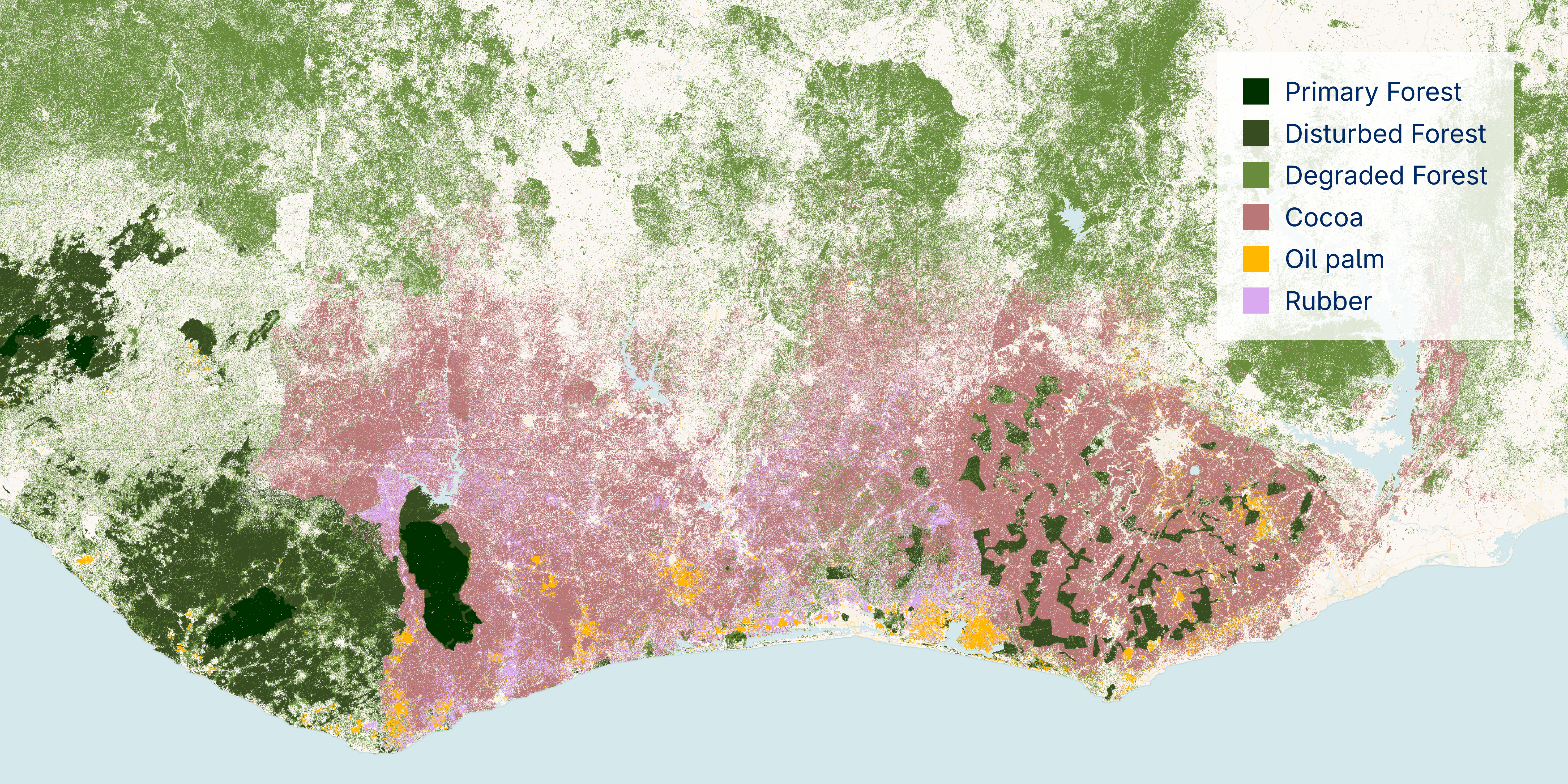
A Nature and Commodity Baseline (when built on credible data) is the foundation for consistent deforestation risk assessments, supplier engagement, regulatory compliance (such as the EU Deforestation Regulation – EUDR) and long-term supply chain resilience. Without a trusted reference layer, organisations cannot make confident or defensible sourcing decisions.
The World Cocoa Foundation’s newly published Cocoa Deforestation Risk Methodology reflects this necessity, setting out best practices for building robust baselines, assessing risk, and considering mitigation measures when deforestation or associated risk is confirmed. Although developed for the cocoa sector, many of the recommendations have wider relevance to other agricultural commodities such as soy, palm oil, coffee, and beyond. For example, the emphasis on integrated baselines, independent accuracy assessment, and transparent decision-making reflects principles that are becoming increasingly important across all forest-risk commodities. Additionally, it acknowledges the need to assess risk not only inside but also around the plot, checking the broader landscape for risks of illegal expansion in adjacent areas over time.
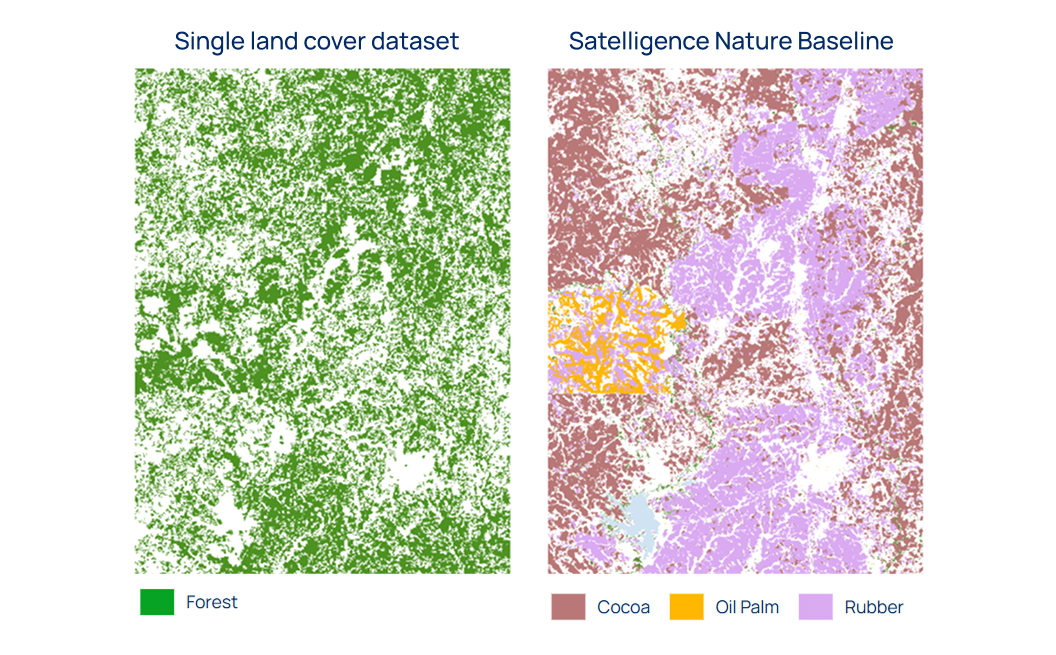
For Satelligence, these recommendations reinforce our long-standing approach to risk assessment and risk mitigation processes, best practices that have been baked into our work from the beginning. A particular example of this is our own forest and ecosystem baseline, the Satelligence Harmonised Nature & Commodity Baseline. Rather than relying on a single land cover dataset, we have curated and harmonised over 80 peer-reviewed global, regional, and national datasets to create a single, consistent reference layer that is continuously improved and updated. As industry methodologies continue to evolve, this robust baseline plays an important role as the foundation for credible, defensible sourcing decisions for resilient growth.
Industry methodologies recommend baselines that are:
- Built from multiple complementary datasets
- Independently validated where possible
- Credible, transparent and well-documented
- Appropriate for the local context
- Supported by clear quality assessment
Why are nature and commodity baselines becoming an industry best practice?
It used to be the case that organisations needed to choose between competing forest and land cover datasets, with various methodologies, strengths, and limitations. Now, rather than asking which dataset is best, the focus has shifted towards how multiple sources of evidence can be combined to create the most robust foundation for decision-making.
We see this change reflected across emerging industry guidance; rather than prescribing a single data source, methodologies are increasingly advocating for transparent, documented approaches that evaluate the quality of available datasets, combine complementary and credible data sources, and clearly communicate uncertainty. The goal is not simply to improve mapping accuracy, but to create a consistent reference layer that organisations can confidently use for risk assessments, reporting, and supplier engagement.
These principles have long underpinned Satelligence’s Nature Baseline. Built using a convergence of evidence approach, it integrates multiple forest and land cover datasets, prioritising sources based on their validated quality and suitability for the local context.
This approach recognises that no single dataset is perfect. By combining multiple sources of evidence and applying consistent quality assessment, organisations can reduce the limitations of individual datasets and create a more reliable basis for downstream decisions.
From our experience of watching and contributing to the industry’s maturity in Nature Intelligence, we have seen this convergence of evidence become less of a differentiator and more of an expectation.
Why is a nature and commodity baseline (based on credible data) so important?
Because every deforestation assessment depends on an agreed reference layer. Without one, organisations cannot consistently determine whether forest loss has occurred, assess supplier risk, or apply mitigation measures fairly across their supply chains.
Why does baseline quality matter?
When it comes down to it, a baseline is more than a technical reference layer. It is the foundation for decisions that can have significant consequences for producers, suppliers, and companies sourcing forest-risk commodities. Should deforestation be identified within a supply chain, organisations need to determine an appropriate response: whether further investigation is needed, whether they can take corrective action, or whether sourcing decisions need to change.
This requires complete confidence that the underlying assessment is based on accurate, transparent, and consistent information. Misclassification of forest undermines the credibility of risk assessments, complicates supplier engagement, and may unfairly penalise and exclude farmers from the supply chain. But when decisions are based on trusted intelligence, companies can respond more effectively, addressing genuine risks while maintaining constructive relationships with suppliers (and other stakeholders) committed to improvement.
Conclusion
The need for trusted methodologies and reliable reference layers is growing. Companies are looking to these not only to understand where risks exist, but to make confident decisions about where to focus action and investment.
Robust baselines provide this foundation. By combining multiple sources of evidence, transparent methodologies, and ongoing validation, they help organisations move beyond simply identifying where risks exist towards understanding how to address them. This enables companies to strengthen compliance, reduce risk of regulatory fines and market disruption, and engage suppliers with greater confidence.
Just as crucially, credible data helps ensure that sustainability efforts have the greatest possible impact. By accurately identifying where deforestation occurs and applying consistent mitigation approaches, companies can direct resources where they are most needed, thus supporting healthier ecosystems, more resilient supply chains, and long-term value creation.
The emergence of approaches such as the World Cocoa Foundation’s Cocoa Deforestation Risk Methodology reflects a broader shift: credible sustainability commitments depend on credible data. As supply chains become more transparent, competitive advantage will depend more and more on the ability to transform trusted environmental data into consistent, evidence-based sourcing decisions.
Key takeaways
- A nature and commodity baseline is the reference layer used to assess deforestation and land-use change.
- Industry methodologies are increasingly recommending convergence-of-evidence approaches rather than relying on a single dataset.
- Trusted baselines enable more consistent risk assessments, supplier engagement and mitigation decisions.
- Robust nature baselines support resilient, deforestation-free supply chains across commodities including cocoa, soy, coffee and palm oil.