

The World Economic Forum Annual Meeting 2026 reinforced a shift that we at Satelligence have been observing across markets for some time: nature risk, technology, and commercial value creation are no longer separate conversations. They are converging rapidly, and businesses that fail to adapt risk falling behind.
In this blog, we have compiled the learnings from our week attending Davos 2026, drawing together the key conversation points, recurring narratives and challenges, and specific insights from the most valuable sessions.
Key Learning 1: Nature risk is a current business variable
Across open discussions and personal interactions, one message was consistent: nature risk should no longer be framed as a long-term concern.
While global risk frameworks often position biodiversity loss, deforestation, and ecosystem degradation on a far-off horizon, their impacts are already materialising. The WEF Global Risks Perception Survey ranks global risks by expected severity over the short-term (2 years) and longer term (10 years); while nature risks dominate the long-term list, they continue to be left out of the short-term risks in favour of headline-grabbing sociopolitical risks. Meanwhile, we know that disruptions to water availability, ecosystem degradation and broader Earth systems are already affecting sourcing strategies, asset values, and supply chain resilience today.
The implication for boards and executive teams is clear. Nature must be treated as a current strategic variable, integrated into operational and financial decision-making, rather than isolated within sustainability reporting or future scenario planning.
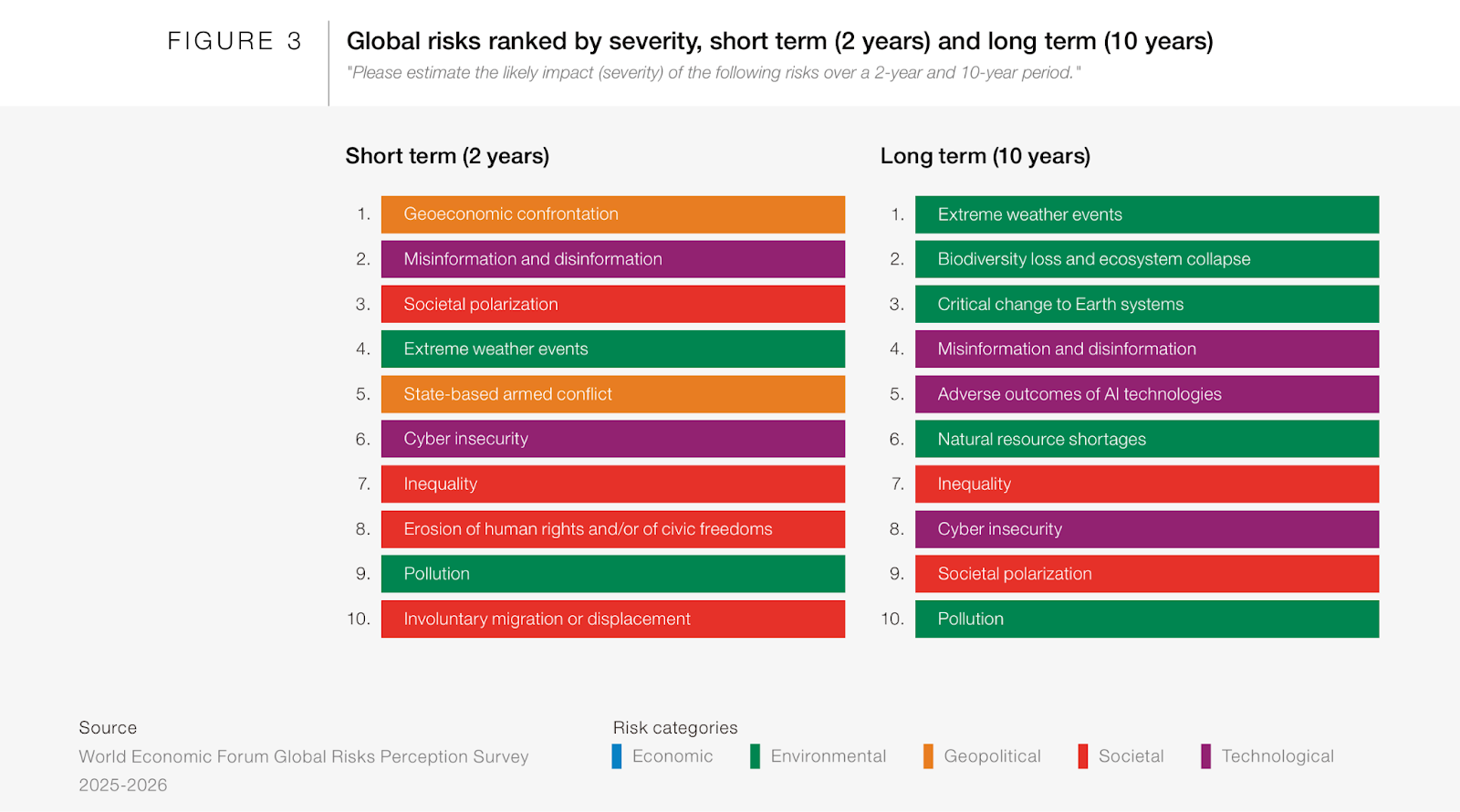
Nature-related risks, including biodiversity loss, ecosystem collapse, and pollution, are projected to be among the most severe global risks over the next decade. Source: WEF Global Risks Perception Survey 2025–2026.
Key Learning 2: Sustainability has become a business resilience strategy
Another strong signal from Davos was the evolution of the sustainability narrative itself.
Sustainability is not disappearing. Instead, it is becoming more operational, more quantitative, and more closely linked to business resilience and return on investment. Many companies are speaking less publicly, but acting more decisively behind the scenes.
Key Learning 3: Earth Intelligence as a strategic enabler
One of the clearest takeaways from Davos was the growing role of AI-enhanced geospatial intelligence (often referred to as GeoAI) as a strategic enabler for business. Advances in quantitative AI, agent-based systems, and space technologies are strengthening earth observation and analytical capabilities. In many cases, the necessary data already exists. The differentiator lies in how that data is integrated, analysed, and translated into decisions that can be acted upon.
By combining satellite data with advanced analytics, companies can:
- Identify nature-related risk and opportunity across entire value chains
- Support procurement, investment, and due-diligence decisions with objective evidence
- Monitor change at scale and with consistency over time
- Align sustainability objectives with operational priorities
At Satelligence, we have been doing exactly this for more than a decade. By combining satellite data with advanced analytics and deep domain expertise, we already enable organisations to identify nature risk and opportunity across entire value chains, support procurement and due-diligence decisions with objective evidence, and monitor land-use change with consistency over time. This is Earth Intelligence in operation, embedded directly into commercial decision-making.
This approach enables organisations to move from fragmented signals to decision-ready intelligence, supporting resilience, compliance, and long-term value creation. In conversation with our Nature & Climate Director (Alan Kroeger), Ethan Soloviev (Chief Innovation Officer at HowGood) highlighted how earth intelligence enables a new level of traceability, interoperability, and sustainability insights from field to fork.
“We are moving beyond training AI on language to training it on earth observation data: satellite imagery, hyperspectral imagery, and how landscapes change over years and decades. This allows us to generate foundational insights at a traceable, field- or polygon-level, even for high-risk commodities.” In the case of Satelligence, we then translate these insights into actionable data for procurement teams, who can then make informed sourcing decisions.
HowGood complements this by translating field-level data into product-level intelligence, enabling product-level carbon footprints that incorporate satellite-based insights, such as deforestation.
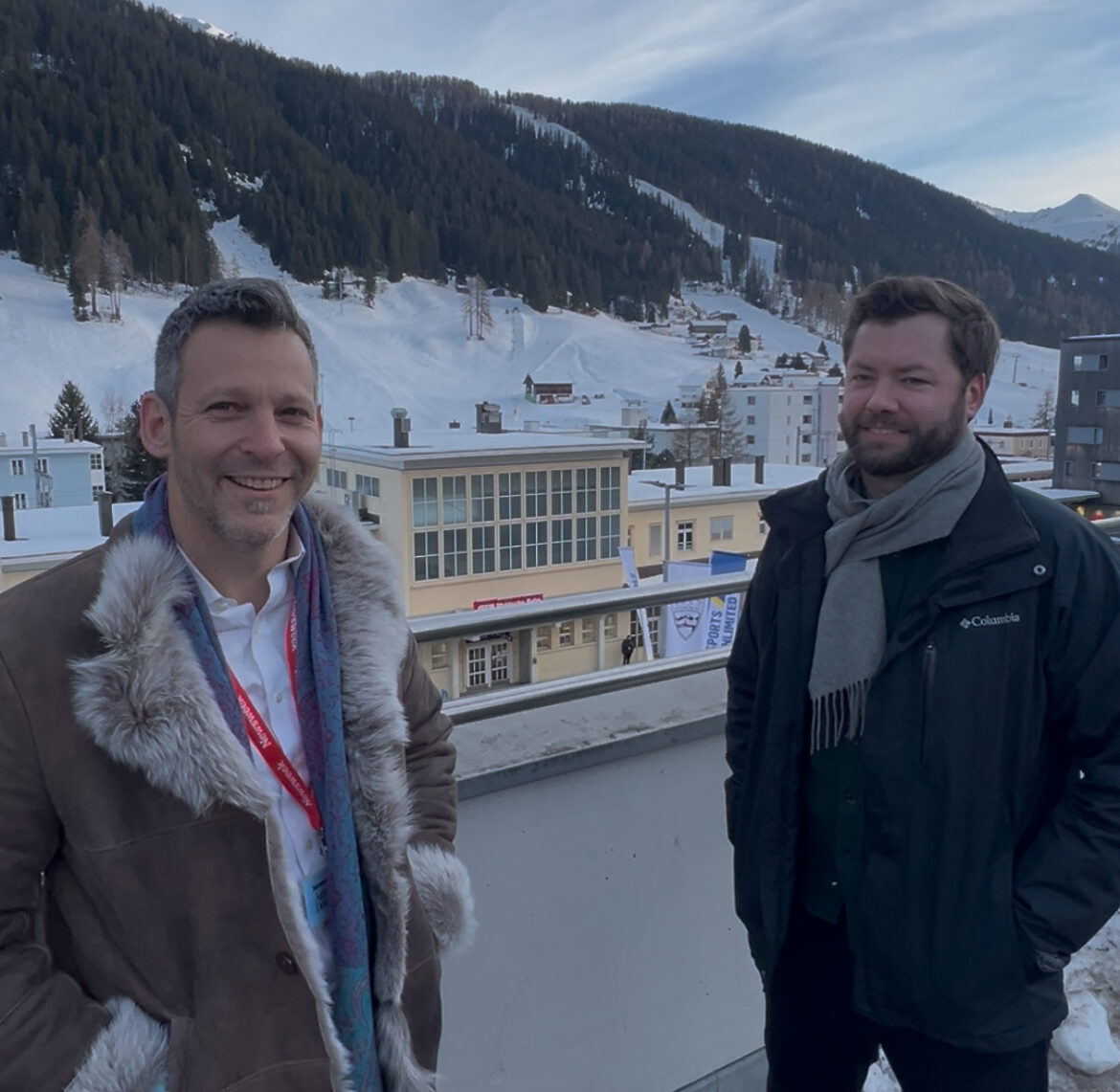
Satelligence Nature & Climate Director, Alan Kroeger, with HowGood’s Chief Innovation Officer Ethan Soloviev In Davos.
From discussion to implementation
Davos 2026 highlighted a growing consensus: companies need to reframe how they think about nature risk. Rather than focusing solely on degradation, there is a growing recognition that nature risk can be converted into opportunity when regeneration is brought into the equation (provided that data is credible, traceable, and decision-grade).
In fact, at the Deloitte & Chapter Zero Alliance event launching the “Guiding Principles for Climate and Nature” for the boardroom, former-CEO of Unilever Paul Polman challenged how companies typically look at nature risk. He noted that many companies continue to approach degraded landscapes in the wrong frame of mind; seeing only risk, rather than places in which to invest in regeneration and long-term value creation. Earth AI enables organisations to assess both degradation and regenerative potential at ground level, and translate that insight into the ingredients and products they bring to market.
As we progress through the year, collaboration across the entire industry will be essential to embed Earth Intelligence into core business processes. The direction is clear, but both the challenge and opportunity now lie in implementation.
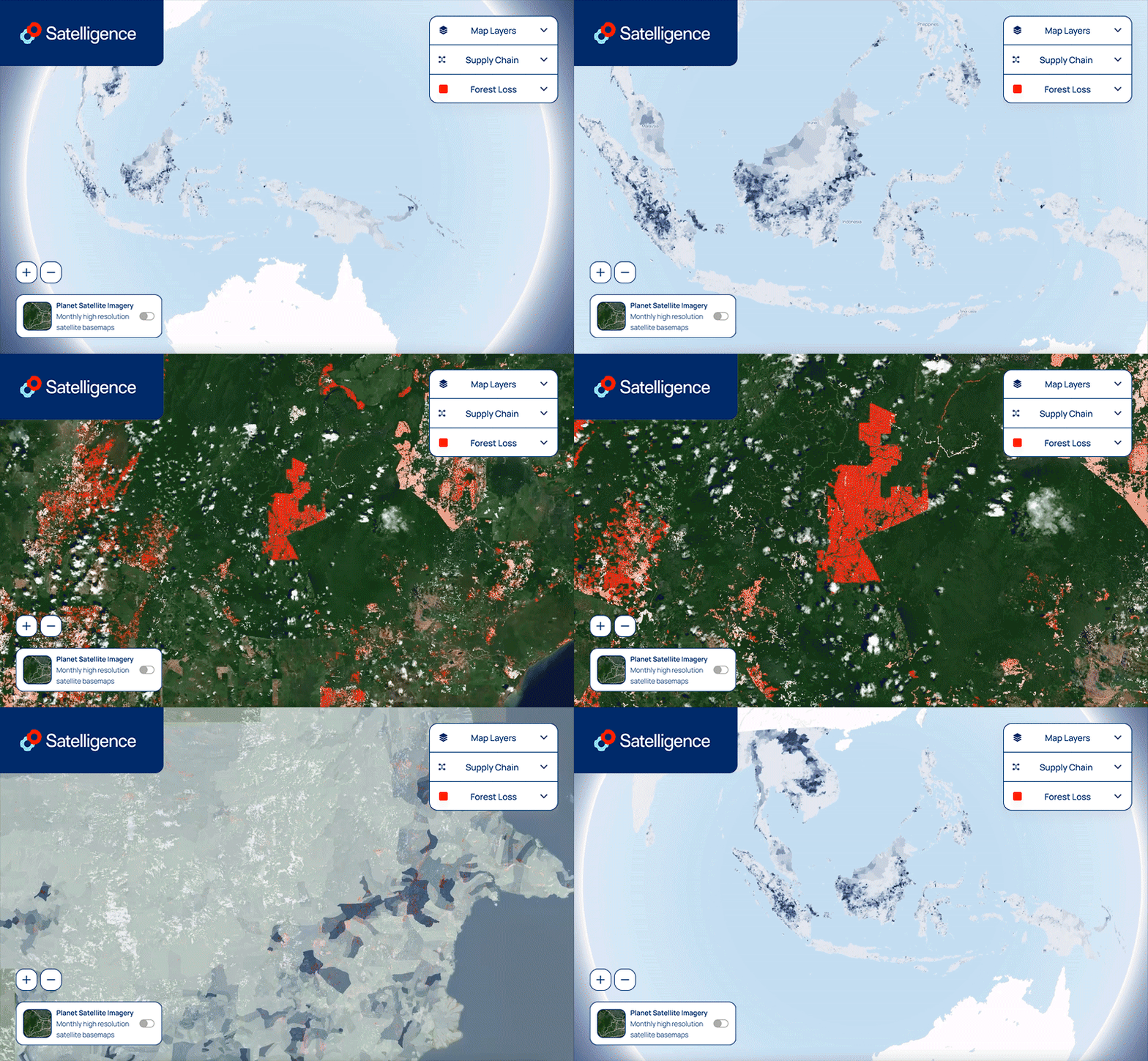
The Satelligence platform enables a detailed view of deforestation across commodities and geographies.
Prepared for what comes next
Many of the themes that dominated this year’s event (treating nature as a current risk, embedding sustainability into core operations, and using AI-enhanced earth intelligence to inform decisions) are not new challenges. What is changing is the urgency and scale at which organisations are now expected to act.
For Satelligence, this reinforces an approach that has been central to our work for more than a decade: translating earth observation, advanced analytics, and on-the-ground experience into decision-ready insights for complex agricultural supply chains.
This long-term perspective means we are well-prepared to support organisations as regulatory, stakeholder, and consumer expectations increase, AI adoption accelerates, and nature risk becomes more tightly linked to financial and operational performance. For our customers, the foundations of robust data, proven methodologies, and scalable technology are already in place.
About Satelligence
Satelligence is a geospatial sustainability company. Their curated and E&Y verified insights on deforestation, supply chains, land degradation, and downstream scope 3 emissions make product journeys and investment portfolios sustainable, from tree to shelf. They’re trusted by Cargill, Unilever, Mondelez, Bunge, Nestle, Pepsico, Tony’s Chocolonely, and more.