

Why data credibility matters more than ever for your EUDR compliance
As companies prepare for compliance with the EU Deforestation Regulation (EUDR), much of the conversation focuses on traceability, due diligence statements, and supplier engagement.
For your sustainability and procurement teams, deforestation monitoring is becoming a key input for sourcing decisions. To avoid costly fines and other penalties, producers flagged as non-EUDR-compliant may be removed from sourcing programmes, subjected to further investigation, or excluded from future business opportunities.
These decisions are designed to reduce risk, but what if the underlying data upon which those decisions are based introduces risk of its own?
When opensource datasets classify compliant production areas as non-compliant, businesses can unintentionally:
- reduce available supply
- increase procurement costs, and
- put commercial value at risk
This can entail several factors leading to penalties and reputational risk.
Penalties of EUDR non compliance
- Non compliance will result in a fine of at least 4% of an organisation’s entire EU turnover in the previous financial year. This fine will increase with repeated cases of non compliance
- Restricted trading in the EU – non-compliant product will be confiscated immediately, further trading restricted
- Access to EU public funds and procurement will be limited or blocked entirely
- High risk of reputational damage
Impact of deforestation data quality in Aceh Tamiang, Indonesia
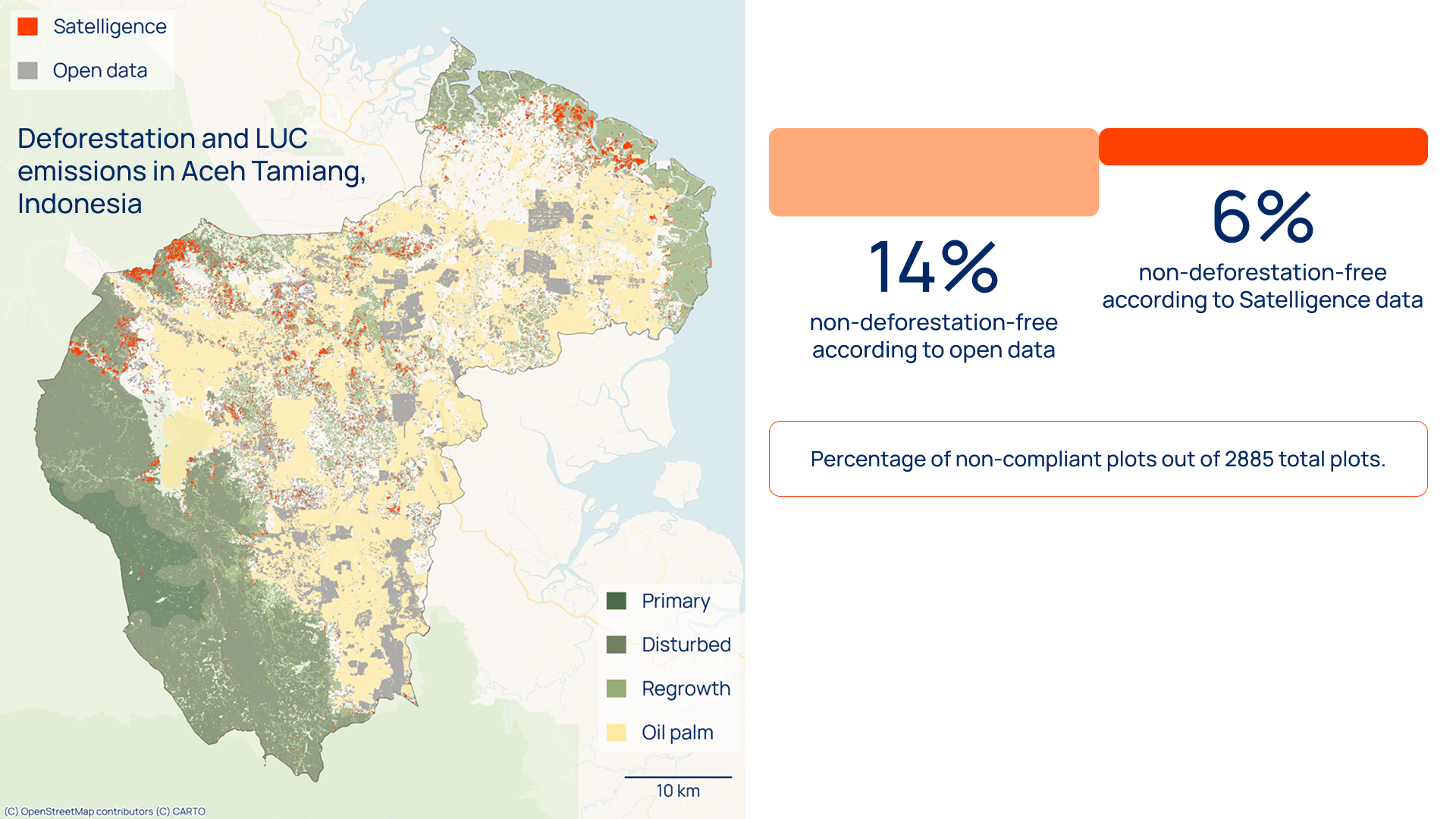
To quantify the impact of data quality, Satelligence analysed 2,885 production plots in Aceh Tamiang, Indonesia comparing open source forest monitoring datasets and Satelligence’s EY-validated methodology.
The results revealed a significant difference:
✔ Using open source data, approximately 14% of plots were classified as non-deforestation-free.
✔ Using Satelligence data, the figure was only 6%.
At first glance, an 8-percentage-point difference may appear relatively small. In reality, the commercial implications are substantial. Because EUDR compliance decisions are often made at scale, even small differences in accuracy can affect hundreds of thousands of hectares of commodity-producing land.
In this assessment, the discrepancy represented more than 900,000 hectares of production area being excluded from supply chains, resulting in a loss of approximately USD $3 billion in potential commercial value.
The question therefore becomes:
How much productive supply are organisations willing to exclude because of uncertainty in the underlying data?
The challenge of false positives
In the context of EUDR, many discussions focus on avoiding false negatives (the risk of failing to identify genuine deforestation). But false positives – the incorrect flagging of a compliant production area as non-compliant – can also create significant business challenges.
For procurement teams, this can lead to:
- Unnecessary supplier exclusions
- Reduced sourcing flexibility
- Increased pressure on alternative supply channels
- Significant loss of commercial opportunities
At scale, these impacts can extend far beyond compliance teams and become a supply chain resilience issue. The credibility of the data your supply chains depend on is a business metric, not just a technical detail.
How data quality affects EUDR decisions
Not all deforestation monitoring approaches are built the same.
Many organisations rely on global open datasets because they are widely available and relatively easy to access. While these datasets play an important role in forest monitoring, contributing a valuable foundation, they are not designed for plot-level compliance decisions.
EUDR requires companies to make decisions that can directly affect suppliers, sourcing strategies, and market access. Those decisions demand a higher level of confidence.
Satelligence’s methodology combines satellite imagery, local calibration, forest-type differentiation, and continuous validation to improve classification accuracy. This approach has been independently assessed by organisations including EY and CIAT helping companies make compliance decisions with greater confidence.
What’s next
EUDR will be implemented in December 2026. Every risk assessment has the potential to influence supplier relationships, sourcing decisions, and access to key markets. When those decisions are based on inaccurate or insufficiently validated data, businesses risk unnecessarily excluding compliant supply, increasing operational costs, and creating costly disruption across their supply chains.
The difference between 14% and 6% is not simply an 8-point variation in deforestation assessments. It represents the difference between confident, fully-informed decision-making, and making decisions with uncertainty.